
Walking Arenal's Lava Landscape: An Unhurried Morning Near La Fortuna
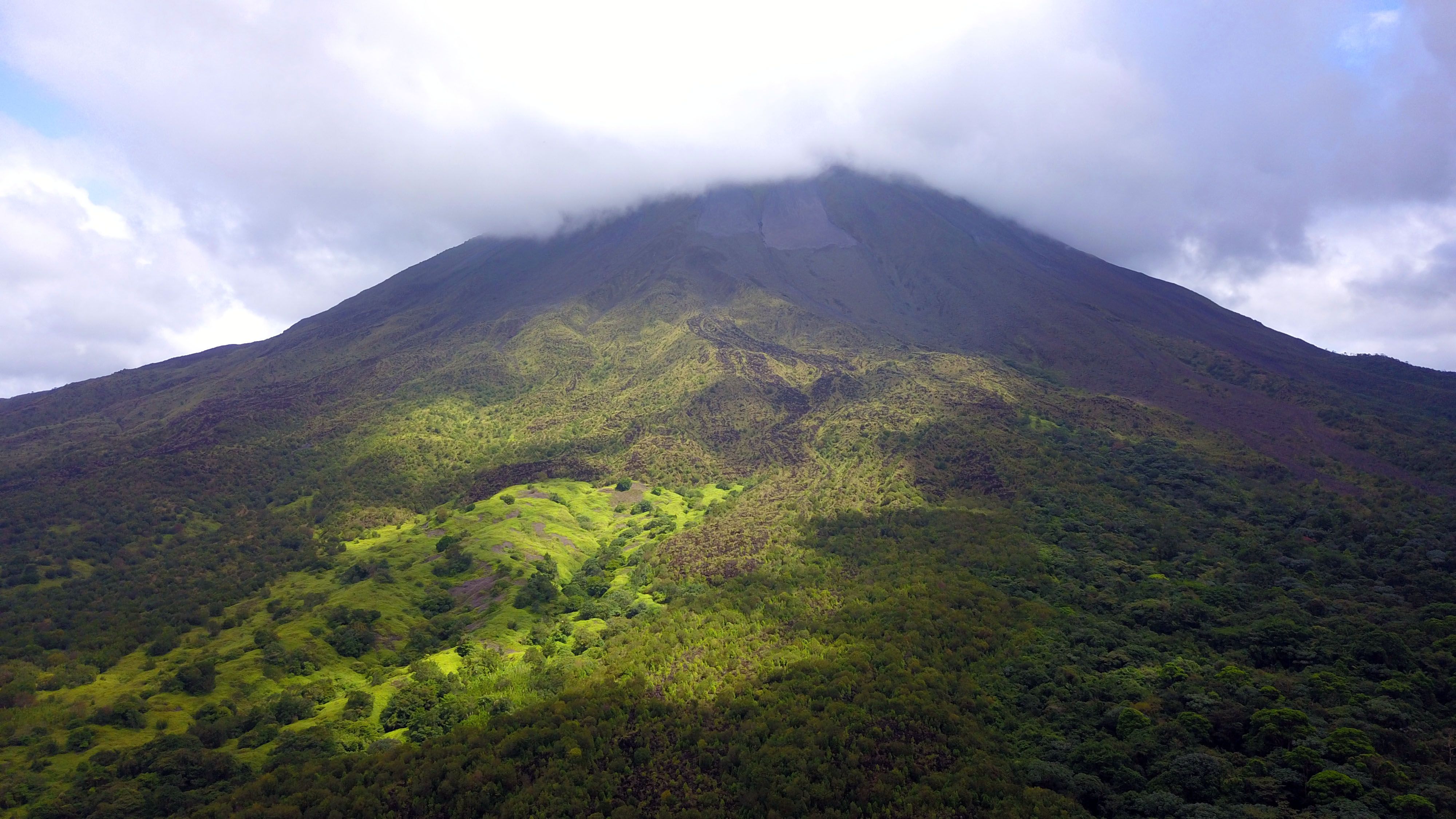
Arenal is easy to admire from a distance. It appears between trees, above rooftops, and — on a clear morning — almost perfectly framed from roads around La Fortuna.
Walking through the landscape shaped by its eruptive past is different.
At Arenal 1968, forest gradually gives way to dark volcanic rock, uneven ground, and open views toward the cone. There is no need to rush through it or turn the visit into a full-day expedition. A morning gives you enough time to walk slowly, stop when the volcano appears, and notice how the forest is reclaiming ground that looked very different less than six decades ago.
Before the hike: what happened in 1968
On July 29, 1968, at around 7:30 a.m., Arenal erupted after centuries without known eruptive activity. The event opened new craters on the volcano's western flank and sent ash, rock, and pyroclastic currents toward communities on that side. Tabacón, Pueblo Nuevo, and San Luis were among the places most heavily affected, and around 80 people lost their lives.
La Fortuna, on the eastern side of the volcano, escaped the worst of the destruction. And July 1968 was only the beginning: the eruption initiated an active period that continued for more than four decades, ending in 2010. Arenal has not erupted since. OVSICORI continues to monitor the volcano and lists it at its lowest activity level, "Calm," in its 2026 reports.
That history changes the way the hike feels. This is not simply another viewpoint toward Arenal. You are moving through a landscape that still carries visible evidence of a remarkably recent volcanic past.
From rainforest to volcanic rock
Arenal 1968 now maintains several hiking routes through regenerating forest, open ground, and volcanic terrain. Its current site describes three trails of varying difficulty centered on the landscape shaped by Arenal's eruption.
For a slower visit, we like beginning on the forested side.
Around Lago Los Patos, vegetation closes in and the mood is quieter. Birds move through the trees and across the water, and for a while the hike feels more like a rainforest walk than a volcano trail.
Then the ground changes.
Dark rock begins to appear beneath your feet. Large volcanic blocks break up the landscape, the canopy opens, and the volcano feels much closer. What makes this part memorable is not simply the rock itself but the boundary between two landscapes: exposed volcanic ground on one side and forest steadily returning on the other.
The trails are manageable for most reasonably active visitors, but sections of volcanic rock are uneven and can become slippery after rain. Closed-toe shoes with decent grip are worth bringing.
Don't make the volcano view the whole point
Arenal 1968 has excellent viewpoints, but the cone does not work on anyone's schedule.
Cloud can move in quickly around La Fortuna, and no month guarantees a clear volcano. Early mornings often offer better odds before cloud builds around the summit, but even then conditions can change within minutes.
The best approach is to treat a full view of Arenal as a bonus rather than the purpose of the hike.
If the clouds open for ten minutes, stop and enjoy it. If they do not, the walk still works: volcanic terrain, regenerating forest, birds, and the strange closeness of a landscape that changed dramatically within living memory.
For a month-by-month look at rain, visibility, and the rhythm of travel here, see our guide to the best time to visit La Fortuna.
Arenal 1968, the National Park, or Observatory Lodge?
You do not need to hike all three. They overlap geographically, but the experience is different enough that choosing according to what you actually want from the day makes more sense.
Arenal Volcano National Park is the SINAC-managed option. Its 1.7-km Las Coladas Trail reaches a lava flow dating to 1992, rather than the initial 1968 eruption. The park is open daily from 8:00 a.m. to 4:00 p.m., and SINAC currently lists admission at $15 for non-resident adults.
Arenal Observatory Lodge & Trails is a better fit if you want to spend longer exploring forest. Its property has roughly 11 km of trails, along with hanging bridges, a waterfall, observation towers, and the Lava Vieja trail. Current pricing is $22 for the Entrance Pass or $40 for the Day Pass, which includes lunch.
Arenal 1968 sits somewhere between the two. We would choose it when the main reason for hiking is to experience the landscape associated with the eruption that began in 1968, while still keeping the outing to an easy half-day.
For most travelers, one well-paced volcano hike is enough. There is little reason to spend a precious day in La Fortuna moving from one similar trail network to another simply to check all three off a list.
How much time to allow
Give yourself about three hours if you want to walk comfortably, with extra time if you enjoy photography, birdwatching, or waiting for the clouds to shift.
The reserve is roughly 15 km from La Fortuna. In normal conditions, expect around 20–25 minutes by car, depending on traffic and exactly where in town you start.
A 4×4 is not normally necessary. Rental car, taxi, private transfer, or a tour that includes transportation are the simplest options; there is no convenient public bus that takes you directly to the entrance.
Current price and hours
As of our August 2026 review, recent published rates for the hiking entrance are approximately $28 per adult and $16 for children ages 6–11, with the final entrance generally at 4:00 p.m.
Arenal 1968 has recently expanded its range of activities, and its official site now sends bookings through an external reservation system, so check arenal1968.com for the latest price and schedule before visiting.
Parking and restrooms are available, along with food and drinks on the property. Guided hikes are also offered if you would rather explore with someone who can explain the eruption, volcanic processes, and forest regeneration as you walk.
What to bring
You do not need technical hiking gear, but La Fortuna's weather rewards a little preparation:
- closed-toe shoes with good grip
- water
- a lightweight rain jacket
- sunscreen
- insect repellent
- a hat
Some sections are exposed enough to feel hot under direct sun. Twenty minutes later, you may be walking in rain. That unpredictability is part of the landscape here.
A morning is enough
The nicest way to experience this hike is not to turn it into a mission.
Arrive early. Start in the forest. Slow down when the ground turns to rock. If Arenal stays behind the clouds, keep walking. If it appears, stop.
By lunchtime, you can be back in La Fortuna with the rest of the day still open — perhaps for hot springs, a long lunch, or an entirely different landscape around one of the area's rivers and waterfalls. Our guide to less-crowded waterfalls near La Fortuna has a few ideas if you want to trade volcanic rock for water.
And if you are spending a few days with us at Ave de Fuego, this is exactly the kind of outing that fits naturally into a slower stay: close enough for a morning, interesting enough to remember, and short enough that it does not take over the day.
Sometimes that is a better way to experience La Fortuna.
Prices, opening hours, and operating conditions were reviewed against sources available in August 2026. Because they can change, confirm current details directly with each attraction before visiting.